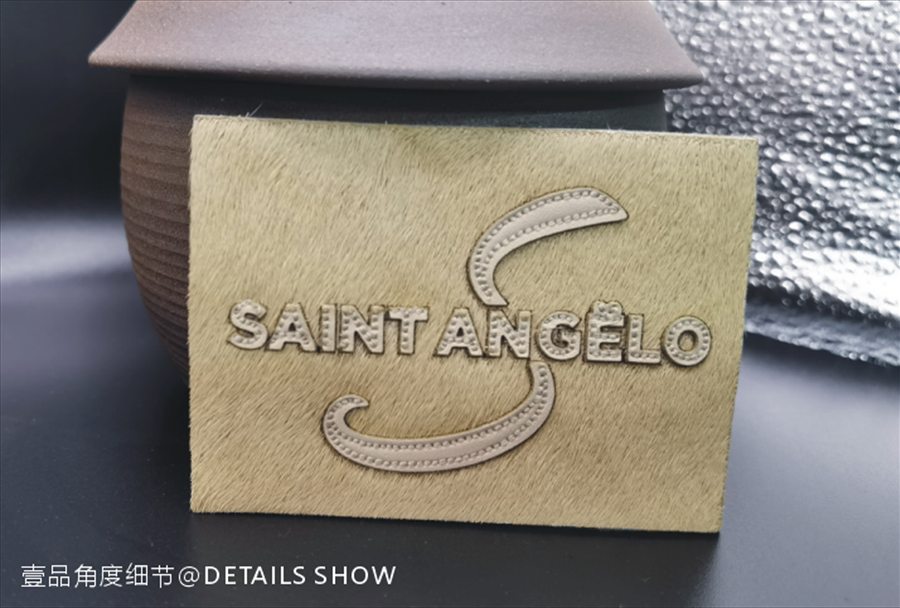
SAINT ANGELO
SAINT ANGELO horsehair appliqué patch
- Product No.
- R001464
- Classification
- Horsehair appliqué patch
A cap's front patch is the visual centre of the whole product, and it is made differently from an apparel label.
A hat patch (leather patch for hats or caps) is a leather badge sewn or heat-sealed to the front panel, brim or rear strap of a cap — common on trucker caps, baseball caps, snapbacks and beanies. Because a cap is small, curved and usually shipped in volume, shaped cutting accuracy and bond strength matter more than on a flat garment label. EP TRIM supplies these patches to headwear brands and cap factories, with shape, leather, thickness and backing made to artwork.
Three differences. One: the patch is smaller and the shapes freer, with more cut-outs and fine outlines, so laser or high-accuracy tooling is needed. Two: it goes onto a curved panel, where a flat patch wrinkles — which calls for pre-forming or thinner leather. Three: cap factories usually heat-seal rather than sew, which puts the emphasis on the adhesive layer and heat tolerance.
Temperature: too high scorches the face or blisters PU. Pressure: too low leaves the corners unbonded, too high crushes the surface. Time: too short and the adhesive never fully activates, so the patch comes off at the first wash. At sampling we set these values against your cap fabric — cotton, polyester or blend — and supply bonded trial pieces.
Headwear tends to run in small repeat orders across many designs. Where a mould already exists we can work at lower quantities; a new design needs tooling, which carries a higher minimum — but we can sample a few pieces first so the feel and colour are settled before volume.
We make the patch itself, not finished hats. The cap is produced by the headwear factory; we supply the front patch to that factory's or the brand's specification, including the adhesive backing and the parameters needed for heat sealing.
Not when the parameters are right and the adhesive matches the cap fabric. The risks are a water-repellent or blended fabric, insufficient press temperature, or a wash hotter than the adhesive tolerates. We validate with trial pieces on your fabric before fixing production settings.
Yes. Fine outlines and cut-outs are laser cut for a clean edge; thicker stock or larger volumes use a CNC mould, which gives better batch consistency. We set out the difference between the two when quoting.
Leather and surface treatment can be chosen for the environment. Where the patch sits against skin over long periods we recommend full-grain cowhide with a sealed edge; PU is weaker against perspiration and suits shorter-life or more decorative designs.
Yes. Send the existing patch or the mould drawing and we will reproduce the shape and size, adjusting slightly if needed to suit your press.
Minimums are agreed per design, and repeat orders on an existing mould can be lower. Sampling is scheduled once artwork and leather are confirmed; production is booked by design and capacity. Send artwork and volume and we will give exact sampling and delivery dates.
SAINT ANGELO
EP TRIM
DIKENI
Materials
A natural full-grain face is not uniform the way synthetic leather is. Wrinkles, scars, insect marks and uneven grain are all normal.
Selection
Even within full-grain cowhide, grain evenness, thickness tolerance and temper vary widely. Material selection sets the ceiling on what a finished patch can be.
Use & washing
Any patch going onto a garment that will be heavily washed must be trial-run first, and bright-coloured patches must not be paired with pale fabric because of colour bleed.
Send us your layout or a physical sample. We will come back with a proposed process and sampling lead time before we talk volumes.